How Invisible Waves Have Changed the World
2026-04-28 [Petri]
I’ve been experimenting with the use of AI for various tasks. It has been a mixed bag on my most familiar application area of writing code snippets, but where I think it excels is using it for ideation as a reference and cross-checking tool. Here’s a practical example of designing a full-coverage Internet on the Moon.
Knowing that the Lunar polar regions are the most conductive for permanent bases, I started my research by asking Claude how many microwave links would be needed to have pole-to-pole data connection. Claude stated the familiar maths matching the curvature of the Moon’s surface and came to the conclusion of approximately 170 link towers of 100 m height would be needed.
The first indication of Claude not exactly understanding the context was its claim that the 100 m towers would be excellent platforms for solar panels. The issue, of course, is the 14-day Lunar night, and the provision of battery reserves that can handle that time span, plus the -130 C coldness, which would require spending part of the energy for local heating capacity as well.
So the next step was something I already knew, but asked anyway: is there a similar geostationary orbit for the Moon as there is for the Earth?
Claude correctly stated that yes, the orbit does exist, but it is beyond the Lunar gravity well, and any object there would be subject to Earth’s gravity, making that orbit unstable for use. It then evaluated other orbit options, and even indicated that it was familiar with information of Nokia’s proposed Lunar LTE network, which is an adaptation of off-the-shelf tech for radio communications covering an area of several tens of square kilometers around a base station, with optional optical link to Earth.
Not a satellite-based system, but within the context of discussion, so it was a nice addition to see.
Now that the lunar-stationary orbit was out, I asked Claude to suggest a Starlink-like constellation that could cover the total area of the Moon.
Again, several pages of reasoning with maths followed, so any claims would be easy to manually cross-check. It correctly listed the benefits and problems of Lunar orbital conditions vs. Earth: smaller sphere, meaning less area to cover, no atmospheric drag, no ionospheric interference but gravitational anomalies to worry about.
Claude proceeded by selecting a 100 km altitude as the “sweet spot”, which later on did not turn out to actually be the best solution, and by deducting the factors for that orbit, it came out with a full coverage claim by using only about 50 satellites.
But in its final conclusion list, it already planted the seeds for selecting a different altitude: namely, the closer you orbit the Moon, the more you are affected by the non-uniform gravity field. Thus, satellites on lower orbit would need thrusters for occasional compensation. This would require a heavier design, plus the fact that inevitably the propellant is going to run out, meaning that a constant replacement plan must be in place, like what happens with Starlink.
But these replacements need to be done some 400,000+ km further away, so they would be costly.
In that earlier summary list, Claude concluded that for 300 km altitude, about 80-100 satellites would suffice, and they would require minimum orbital corrections: maybe just a momentum wheel-based setup, or a tiny ion engine with propellant for decades on board.
This was expecting Starlink-like throughput of 100+ Mbps.
At this point, I wanted to cross-check Claude against ChatGPT by asking the exactly same question. Interestingly, it initially optimized the coverage with minimum satellites, suggesting orbits around 700 to 1000 km for stability.
The negative effect of this is that decent throughput would need much larger ground antennas, so I guided it to re-plan with 300 km orbits: as discussed above, the effects of gravity irregularities are almost non-existent at that altitude.
After reasoning with my request of planning for 1 Mbps and 10 Mbps bandwidths in terms of ground equipment, meaning simple antennas without phased arrays, ChatGPT also concluded that a constellation of around 60 satellites would suffice.
So both bots were on the same ballpark (60-100 satellites), probably the main difference was that I demanded less bandwidth from ChatGPT.
I continued with planning an additional Moon-Earth Internet linkage, and both chatbots agreed on similar laser-based solutions again, with numerous ground stations on Earth’s driest/least cloudy locations, as well as Lunar GNSS systems, but those are beyond the scope of this blog.
More on this growing area of space communications is found in chapter "Let There Be Light" of my book.
All in all, having an AI session that drills into details is a good starting point. As the technology, apart from the final "product placement", is off-the shelf (both suggested Ku-band for radio), the basic physics and mathematics clearly were in the LLM training materials for both Claude and ChatGPT.
So if your “what if”-problem still is rooted in known physics, bouncing your ideas to AI is helpful.
What is not helpful is their constant praise on how clever my questions were. I hope these and other chatbots would tone that down and act like a pro that they pretend to be, not like a member of Trump's cabinet.
Naturally, when a suitable solution appears to be found, re-evaluate, check and cross-check. And not only against other AI bots, although it is a good sanity check during the process. In my example case, knowledgeable RF engineers can be found to do the final planning and run the project teams.
There is still a place for competent humans in this new era of AI.
To conclude, the most staggering result of this all has been the relatively low cost of various implementations that the chatbots suggested and then estimated: for just a couple of days’ worth of money burned in recent military operations, we could build a full-fledged setup for Lunar satellite constellation, with Lunar GNSS service to boot.
The money spent fighting for a week or two would give us a permanently manned Moon base.
Instead, the former power house of science, the US, seems to be more willing to dismantle their research infrastructure, make it practically impossible or at least very unpleasant for any foreign talent to move to the US, and channel the “saved” (actually heavily borrowed) money into a military budget that is bigger than the military budget of ALL the other countries combined.
An opportunity for the rest of us to grab the scientist, for sure.
Dear scientists and other specialists: come to Europe, experience a nice work-life balance, healthy food and dozens of diverse cultures, often just a short drive or a high-speed train trip, or a flight away...
Finally, making the adjoined image took six refining prompts and some 20 minutes total on MS Copilot. The last fix made it worse, so this is generation #5, with obvious problem regarding the orbital plane vs. the plans above.
Permalink: https://bhoew.com/blog/en/166
Earlier entries
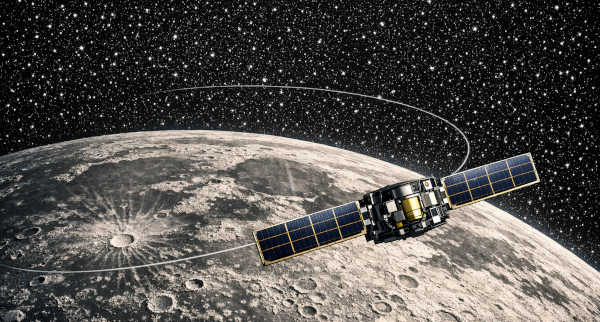
AI rendering for a story about AI [MS Copilot]
You can purchase A Brief History of Everything Wireless: How Invisible Waves Have Changed the World from Springer or from Amazon US, CA, UK, BR, DE, ES, FR, IT, AU, IN, JP. For a more complete list of verified on-line bookstores by country, please click here.
Earlier entries:
You can purchase A Brief History of Everything Wireless: How Invisible Waves Have Changed the World from Springer or from Amazon US, CA, UK, BR, DE, ES, FR, IT, AU, IN, JP. For a more complete list of verified on-line bookstores by country, please click here.
PRIVACY STATEMENT AND CONTACT INFORMATION: we don't collect anything about your visits to this website: we think that your online history belongs to you alone. However, our blog comment section is managed by Disqus. Please read their privacy statement via this link. To contact the author directly, please costruct an email address from his first name and the name of this website. All product names, logos and brands are property of their respective owners and are used on this website for identification purposes only. © 2018 Petri Launiainen.